
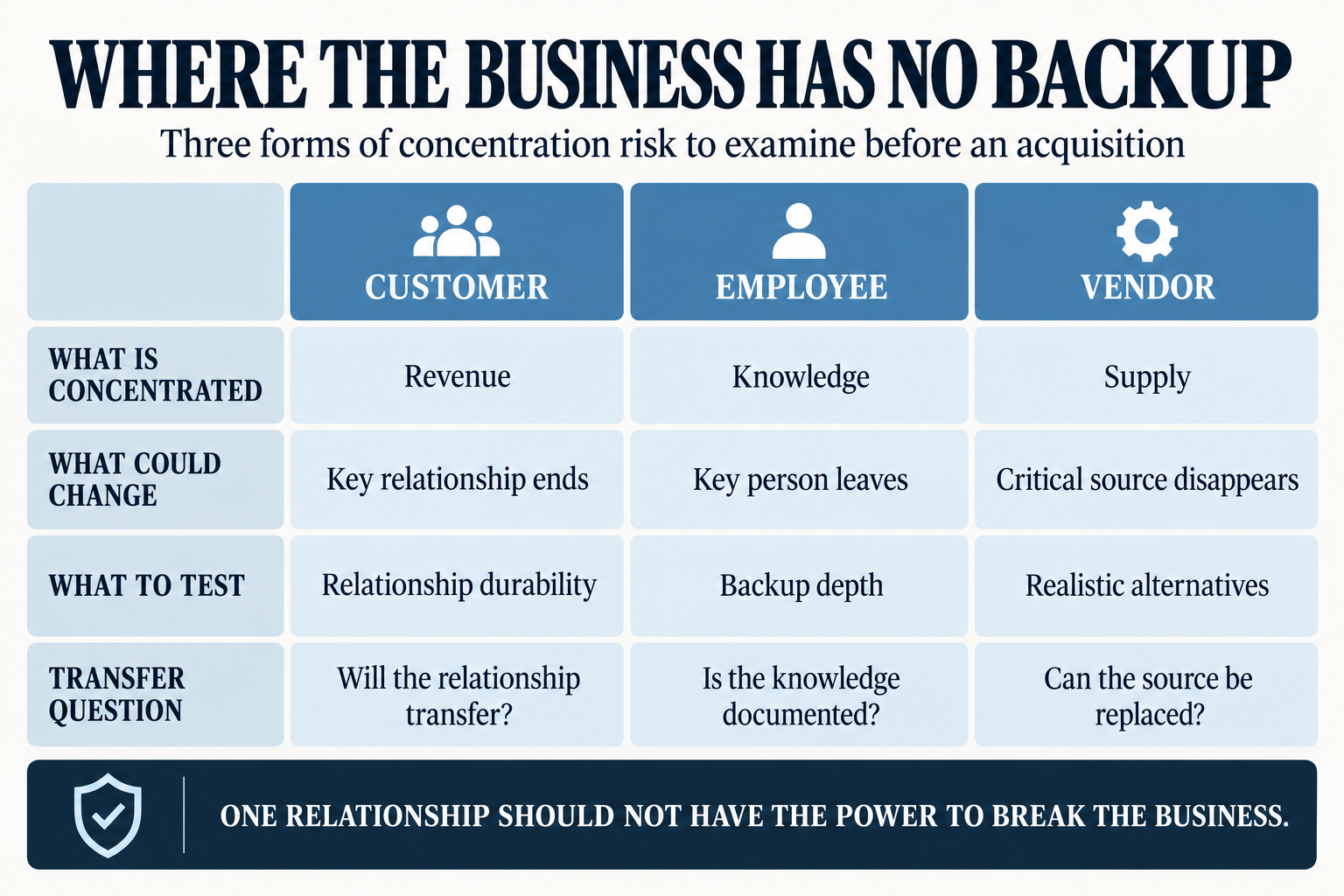
Concentration risk exists when too much of a business depends on one customer, employee, vendor, owner, or other critical relationship. In an acquisition, those dependencies matter because one change can materially affect revenue, operating capacity, knowledge, or continuity after closing.
A business can look diversified because it has dozens of customers, a full team, and several vendors.
Then you start asking better questions.
One customer may account for a disproportionate share of the revenue.
One employee may understand the system nobody else knows.
One vendor may be the only practical source for something the company cannot operate without.
On paper, those are three different issues.
From an operator's perspective, they are versions of the same problem.
Too much of the business depends on one relationship.
That is concentration.
And concentration matters because an acquisition is partly a transfer of responsibility. The buyer needs to understand what will continue working after the seller leaves, what depends on relationships that can transfer, and where one change could create consequences across the rest of the company.
What customer concentration risk means in an acquisition
Customer concentration usually gets attention because it shows up directly in revenue.
If one relationship carries an unusually large share of the company, losing that customer could materially change the business.
That is worth understanding.
But I would go deeper than the number itself.
Why does the customer stay? Who owns the relationship? Is the relationship with the company, or primarily with the seller? What does the customer depend on the business for? What would change for them after an ownership transition? How stable has the relationship actually been?
Those questions help you understand whether the concentration is simply visible in the financial statements or whether there is additional transition risk underneath it.
A long customer relationship can be valuable.
It can also become dangerous if everybody assumes longevity automatically means permanence.
Diligence is where assumption turns into something you can examine.
An employee can carry concentration risk too
Some of the most important people in a business do not have the most impressive title.
They are simply the person who knows how everything works.
They know the customers. They know the exceptions. They know which vendor to call. They know the pricing history. They know how to fix the problem when the formal process fails.
That employee may be enormously valuable to the company.
The risk begins when important knowledge exists only with that person.
If the company cannot explain, document, distribute, or eventually replace that knowledge, then the business has a dependency.
A buyer needs to understand that before closing because the person is part of the operating reality even if they are not part of the transaction documents.
This is one of the reasons operational diligence matters as much as financial diligence.
You are not simply checking payroll.
You are learning where the company actually keeps its ability to function.
Vendor concentration can hide until something breaks
The same issue can sit on the supply side.
A business may depend heavily on a vendor for inventory, technology, fulfillment, specialized expertise, equipment, or another essential input.
As long as the relationship works, it can disappear into the background.
Then terms change. Availability changes. The vendor relationship changes. Or the seller leaves and the buyer discovers the relationship was less institutional than expected.
Again, the right question is not whether concentration automatically disqualifies the business.
The question is what the concentration means.
How difficult would the relationship be to replace? How much operating disruption would a change create? Who manages the relationship today? What obligations exist? Are there practical alternatives? Does the company understand the dependency and manage it intentionally?
Those are diligence questions.
Concentration changes the quality of otherwise attractive numbers
This is why I do not like evaluating businesses by one headline metric.
Revenue can be strong. Margins can be strong. Cash flow can look good.
The company can still carry operating fragility underneath those numbers.
Customer concentration, owner dependence, employee dependence, vendor relationships, systems, and transferability all help explain how durable the performance may be.
The financial statement tells you the result.
Diligence helps you understand what the result depends on.
That distinction is especially important when a buyer is evaluating a company they did not build.
The seller has lived inside the operating system for years. The buyer is trying to understand it in a much shorter period of time.
Good diligence makes the invisible dependencies visible.
The answer is not always “walk away”
Risk is not unusual in a small business.
The presence of concentration does not automatically tell you whether the acquisition makes sense.
It tells you what deserves deeper examination.
A concentrated customer relationship may have a long history and a credible transition plan.
A key employee may be committed to staying and may also be an opportunity to strengthen leadership beneath the owner.
A critical vendor relationship may be manageable if the company understands alternatives and transition requirements.
Those facts matter.
The goal of diligence is to know what you are taking responsibility for.
That means understanding both strengths and weaknesses well enough to make a decision with your eyes open.
Concentration also tells you what post-close work may matter
Once you see a dependency, you can begin thinking about what would make the company stronger over time.
Could customer relationships be broadened across the team? Could important knowledge be documented? Could decision-making become less dependent on one person? Could the company develop more resilient operating alternatives? Could processes become repeatable enough that somebody else can learn them?
Those are value-creation questions because they improve the transferability of the business.
A stronger company does not require every risk to disappear.
It requires fewer critical parts of the company to depend on one person or one relationship indefinitely.
Look for the places where the business has no backup
One of the simplest questions I like in evaluating a company is this:
Where does the business have no backup?
One customer. One employee. One vendor. One owner. One system. One source of information.
Those are the places where a buyer should slow down and understand what is actually happening.
The business may still be excellent.
But if one relationship has enough power to materially change the company when it changes, you need to know that before you own the consequence.
That is what diligence is supposed to do.
It turns the story of the business into something you can examine, question, and ultimately decide whether you are prepared to lead.
Back to all articles