
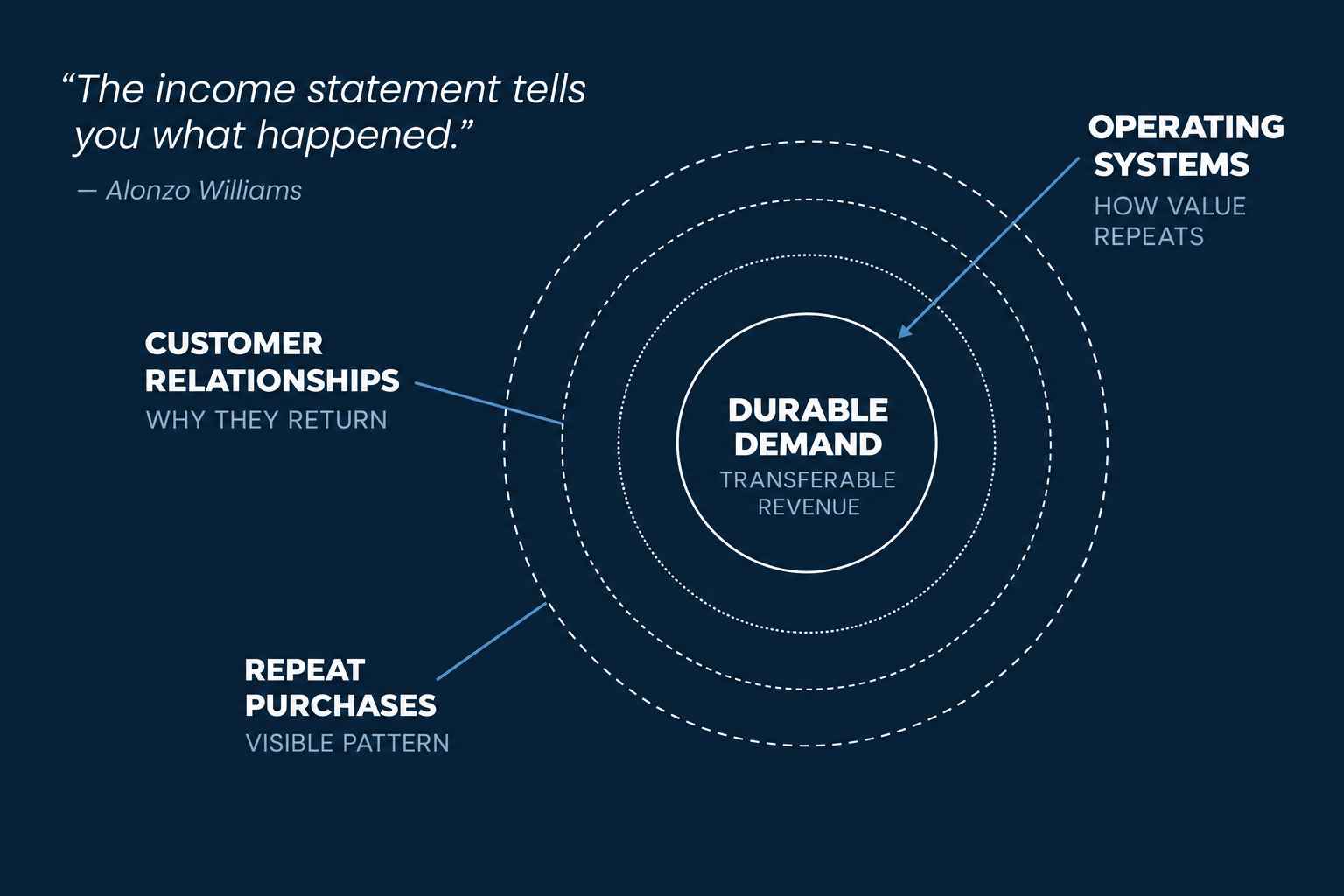
Recurring revenue matters in a business acquisition because it can make future demand easier to understand and reduce how much revenue must be recreated from zero. But recurring revenue is only as strong as the customer relationships, systems, and operating dependencies behind it.
Revenue tells you what a company sold.
The quality of that revenue tells you something different. It tells you how much of the business has to be won again tomorrow.
That distinction matters when you are evaluating an established company because two businesses can show similar top-line numbers and still carry very different operating risk.
One may begin every month with customers already expected to return. The other may begin every month needing to replace most of what it sold the month before.
Those are different businesses.
When I look at the quality of a company, predictable and recurring revenue is one of the things I want to understand because it connects directly to how the business operates, how dependent it is on constant selling, and how transferable the company may be to a new owner.
Why recurring revenue matters beyond the revenue number
A buyer can look at a financial statement and see revenue, margin, and earnings.
Those numbers matter. They just do not answer every question.
I also want to understand how the revenue is produced.
Are customers returning because there is an ongoing need? Does the business have a repeatable relationship with them? Does the company know where next month's work is likely to come from? Or does the owner have to go back into the market and recreate demand over and over again?
The more revenue depends on a fresh selling effort every single time, the more attention I give to the sales engine behind the number.
That does not automatically make the business bad. It means you need to understand what keeps the revenue moving.
Predictability gives an operator something to manage
Operating a company gets easier to understand when you can see patterns.
If revenue repeats with some consistency, management has a stronger starting point for decisions around people, capacity, working capital, customer service, and growth.
You are still running a business. Customers can leave. Markets can change. Costs can move. Nothing about recurring revenue removes the responsibility of operating well.
What it can do is reduce the amount of the company that has to be recreated from zero each period.
That is an important difference.
One of the things I learned from years around operating systems is that the best systems make important work more repeatable. I look at revenue through a similar lens.
If the company knows why customers return and has a repeatable way to continue serving them, that is a stronger operating foundation than a company where the next sale lives primarily in one person's head, relationships, or hustle.
Recurring revenue also raises better diligence questions
The words “recurring revenue” can sound better than the underlying reality.
That is why I would not stop at the label.
I want to know what is actually recurring. How stable are the customer relationships? How concentrated is the revenue? What does the customer expect in return? What has to happen operationally for the customer to keep buying? How much of that relationship belongs to the company, and how much belongs personally to the current owner?
Those questions move you from a revenue description to an understanding of the business.
A company may have customers that purchase repeatedly, but if one owner personally manages every important relationship, the economic pattern may repeat while the operating system remains fragile.
That matters in an acquisition.
The buyer is not simply purchasing last year's income statement. The buyer is taking responsibility for whatever produced those results.
Transferability is the bigger issue
A company becomes more valuable as an operating asset when important parts of it can continue without one individual having to recreate them every day.
Recurring revenue can contribute to that quality because it may make the business less dependent on constantly finding the next transaction.
But it belongs inside a bigger picture.
I would look at recurring revenue alongside leadership, documented processes, customer relationships, operating data, owner dependence, and the people required to keep the company running.
That combination tells you more about transferability than revenue alone.
This is where I think buyers sometimes get distracted by size.
A larger company is not automatically a better company. A company with more revenue is not automatically easier to operate. What matters is what is underneath the number.
Recurring revenue can still carry concentration risk
The same diligence that makes recurring revenue attractive should also make you cautious.
If repeat business depends on one customer, one employee, one referral source, one vendor, or the current owner's personal involvement, then the revenue may be more fragile than it first appears.
That is why customer concentration and recurring revenue belong in the same conversation.
Predictability is useful when the underlying relationships are durable enough to transfer.
If the company loses its largest relationship the week after ownership changes, the historical recurrence does not help nearly as much as the buyer expected.
So I am interested in the pattern, but I am also interested in what creates the pattern.
That is where operator judgment comes in.
A better question than “How much revenue?”
When someone is evaluating an established company, I would encourage them to move one step beyond the obvious question.
Do not only ask how much revenue the business produced.
Ask how the revenue behaves. Ask how much has to be sold again. Ask what causes customers to return. Ask where the relationships live. Ask how dependent the result is on the owner. Ask what the team and systems have to do to produce it again next month.
Those questions tell you much more about the quality of the asset you may be buying.
The income statement tells you what happened.
Understanding the operating engine helps you judge whether the business has a reasonable chance of continuing to work when responsibility moves from one owner to another.
Back to all articles