
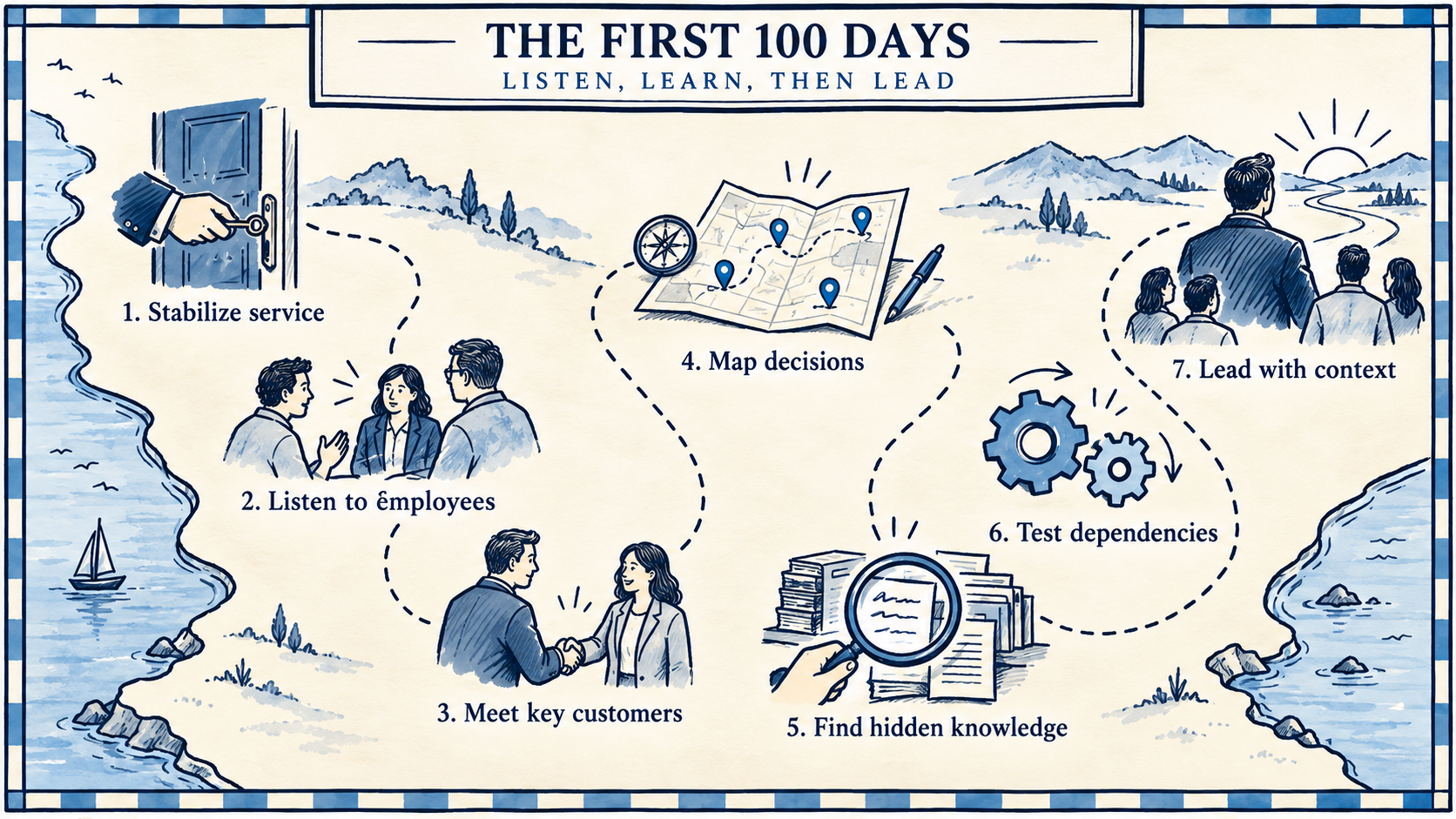
In the first 100 days after buying a business, the priority is to understand how the company actually works before making major changes. Learn the employees, customer relationships, decision paths, former-owner dependencies, and informal operating knowledge first. Then decide what needs to change.
You finally get the set of keys.
That is a big moment.
You have spent months evaluating the business, working through financials, talking to advisors, thinking about structure, negotiating terms, and trying to understand what you are actually buying.
Then the transaction closes.
Now the business is looking back at you.
Employees want to know what is going to change. Customers are still expecting the same service they received yesterday. Bills still have to be paid. Sales still have to happen. Somebody still has to answer the phone when something goes wrong.
And because you are the new owner, it can be tempting to start proving it.
I think that is where a lot of unnecessary damage can begin.
The first 100 days should start with a simpler mandate: listen, learn, then lead.
Start by learning how the business already works
Most established companies have things you will want to improve.
Sometimes you can see them before closing.
The reporting may be weak. The technology may be old. Responsibilities may not be documented. The owner may be involved in too many decisions. The sales process may need work.
Those observations can all be legitimate.
But there is another fact sitting right beside them.
The company was functioning before you arrived.
Customers were buying. Employees knew how work moved through the organization. People had informal ways of solving problems. Certain relationships held the place together.
A new owner needs to understand those things before assuming every inefficiency is simply waiting to be corrected.
Sometimes the thing that looks inefficient from the outside is connected to a customer expectation, an employee relationship, or operating knowledge that has never been written down.
You do not discover that from the purchase agreement. You discover it by paying attention.
Employees know things the financial statements cannot tell you
Financial diligence matters because numbers can expose risk, trends, obligations, and inconsistencies.
But the financial statements cannot tell you everything about how the company actually functions at 10:15 on a Tuesday morning.
The team can.
Who knows how to calm the difficult customer? Who remembers the exception that never made it into the procedure manual? Who is the person everybody walks over to when the system stops working? Which employee holds a relationship the owner believes belongs to the company? Which process looks straightforward until the person who has done it for 12 years explains the five things that can go wrong?
Those details are operating knowledge.
A new owner should learn where that knowledge lives before changing the people, reporting lines, systems, or processes around it.
Customers are watching the transition too
Employees are not the only people paying attention.
Customers notice ownership changes.
Some may have worked with the seller for years. Some may have stayed because they trust a particular employee. Some may be concerned that the new owner will change the service, raise prices, cut staff, or disrupt the relationship.
That means part of the first 100 days is understanding what customers believe they are buying from the company.
What do they value? What do they expect to remain consistent? Who owns the relationship today? What would make the transition feel stable to them?
Those questions matter because customer relationships are part of what the buyer just paid for.
You want to understand them before you accidentally weaken them.
The former owner can still hold invisible parts of the company
Owner dependence is one of the things I pay close attention to when thinking about business quality.
Sometimes the company appears to have employees, systems, customers, and processes, but the former owner is still the person connecting all of them.
The owner knows every customer. The owner approves every exception. The owner handles the important vendor relationship. The owner knows the pricing logic. The owner is the person employees come to when they are unsure.
If that is the situation, the transition deserves careful attention.
The goal is eventually to make the company less dependent on any single person.
But first, you have to know where the dependency exists.
That is why the transition period matters.
When should a new owner start making changes?
A new CEO can feel pressure to demonstrate action.
New dashboards. New meetings. New systems. New job descriptions. New strategy language.
Some of those changes may eventually be exactly right.
Timing still matters.
The first question should be whether you understand the company well enough to know which changes deserve priority.
There is a difference between leadership and activity.
Leadership requires judgment about what should move, what should stay stable, and what you still do not understand.
In the first 100 days, restraint can be part of that judgment.
Learn the decision paths
One of the most useful things a new owner can do is map how decisions actually happen.
Not how the organization chart says they happen. How they really happen.
Who decides? Who influences the decision? Who has the information? What gets escalated? Where does work slow down? Where does the owner personally step in? Which decisions could move lower in the organization if expectations and accountability were clearer?
These patterns tell you where the company has systems and where it has habits.
That distinction becomes important as you begin building a business that can operate with stronger accountability and less dependence on the person at the top.
Then begin strengthening the company
Listening does not mean leaving everything alone forever.
The reason you learn first is so the changes you make have a better chance of improving the asset rather than disrupting it.
Over time, the work may involve stronger leadership, clearer accountability, documented processes, useful operating data, improved customer relationships, better sales and marketing systems, or reduced owner dependency.
But those decisions should come from understanding the business you actually own.
You are trying to strengthen a company, not simply leave fingerprints on it.
That is a very different objective.
The real job of the first 100 days
When somebody buys a business, closing feels like the finish line because so much work goes into getting there.
Operationally, it is the starting line.
You now have people, customers, obligations, systems, cash, and relationships that were already in motion before your name appeared on the documents.
Your job is to understand that motion.
Listen to the people. Learn the customer relationships. Clarify the former owner's role. Find the informal knowledge. See where decisions really happen. Stabilize what needs stability. Then lead from a position of understanding.
You already proved that you are the new owner when the transaction closed.
The next 100 days are about becoming the leader the business needs.
Back to all articles